
Last updated November 18, 2026
 Sliding glass doors
 Single hung
 Double hung
 Horizontal roller
 Casement
 Bay & bow
 Entry doors
 Impact garage doors
 PGT
 CGI
Free in-home measure and quote - PGT, CGI and CWS impact lines compared on your actual openings, style by style
Get your free estimateWindows & Doors Warning Signs: A Boulder City Homeowner’s Reference Guide
The window that costs a Boulder City homeowner the least to fix is the one that already looks broken. A failed thermal seal shows up as fog between the panes, the phone call gets made, the glass gets replaced for a couple hundred dollars. The expensive one is the window that still looks fine. Sill rot hides under a coat of paint. Racked door frames still close, just with a shove. Low-e coating that has quietly cooked off its reflective layer looks exactly like clean glass until you touch it. This guide covers those quiet failures, the ones you can explain away for two or three seasons. We’ll show you how to test for each one, tell you what it actually means, and let you decide when it’s a Saturday afternoon inspection and when it’s a call to a professional.
Quick Answer
The warning signs that cost Boulder City homeowners the most money are the ones invisible from across the room: internal condensation between panes (a failed seal needing glass replacement), sill rot hidden under paint, low-e coating that has burned off, racking door frames on caliche-shifted foundations, and compressed weatherstripping on exterior doors. Most of these can be tested in under ten minutes with your hand, a spray bottle, and a close look at the joints. Catching them early means a repair; deferring them often means a replacement.
Styles & brands we work with
- Single hung
- Double hung
- Horizontal roller
- Casement
- Bay & bow
- Sliding glass doors
- Entry doors
- Impact garage doors
- PGT
- CGI
Table of Contents
- Internal vs. External Condensation: The Twenty-Minute Test
- Racking vs. Sticking: How to Read a Door Frame on Caliche Soil
- Sill Rot Under Paint: What Bubbling and Soft Spots Really Mean
- How to Test for UV-Degraded Low-E Coating by Hand
- Weatherstripping Failure vs. Hardware Misalignment: A Tactile Checklist
- The Boulder City Seasonal Walkthrough
- What Each Warning Sign Costs to Fix vs. to Defer
Internal vs. External Condensation: The Twenty-Minute Test
A foggy window in Boulder City is not automatically a broken window. We’ve seen homeowners spend on glass replacement for condensation that was landing on the outside of the pane, which is entirely normal, and we’ve seen the opposite: a homeowner patting a fogged window dry with a towel for two summers before the seal failure let enough heat through to buckle the flooring beneath it. The test separates a free explanation from a couple hundred dollars.
Here’s how to run it:
- Note the time and the outdoor temperature. Boulder City’s spring mornings routinely swing thirty degrees between dawn and noon, and that swing is what pulls moisture out of the air and onto glass.
- Rub the fogged area with your thumb. If the moisture smears on the exterior surface and disappears with a paper towel, it’s external condensation. If nothing wipes away because the fog is trapped between the panes, that’s internal.
- Check the same window at 2 p.m. External condensation burns off by midday. Internal condensation doesn’t lift because there’s nowhere for it to go.
- Look for a chalky white haze, water spots, or a faint outline around the fog. That’s the signature of a failed thermal seal, where the desiccant inside the spacer has saturated and the gas fill has leaked out.
Internal condensation means the glass unit’s seal has failed. The window frame is almost certainly fine, and the fix is replacing the sealed glass unit (an insulated glass unit, or IGU), not the whole window. If you’re already planning to replace the residential units, the window replacement page for Boulder City covers how the two paths compare on cost and warranty.
Racking vs. Sticking: How to Read a Door Frame on Caliche Soil
A door that sticks in July and swings free in January is a weather pattern. A door that has to be shoved with the hip, then lifted with the handle to latch, is a structural signature, and it’s the one Boulder City homes on expansive caliche soils tend to show. Caliche is a calcium-carbonate hardpan that underlies much of the Boulder City area. When it gets wet, it swells; when it dries under summer heat, it shrinks. Your foundation moves seasonally with it, and your door frames follow. A door binding is a symptom. The frame racking is the diagnosis.
Here’s how to tell which one you have:
- The sound test. Push the top of the door while it’s closed. A racked frame produces a distinct creak or a hollow thump at the top corner, where the header meets the jamb, not at the latch.
- The gap test. Shine a flashlight from inside around the closed door on a dark evening. A racked frame shows an uneven gap that’s wide at the top hinge and narrow or gone at the strike side.
- The scribe test. Look at the reveal line, the visible space between the door edge and the frame. A racked frame gives you a wedge, not a uniform strip.
- The level test. A four-foot level held on the strike-side jamb, both perpendicular and plumb, will show the frame listing. If the jamb is out of plumb by more than about a quarter inch over the door height, the frame has moved.
Why does this matter? Because tightening hinge screws or adjusting the strike plate is the fix for a misalignmed door, not a racked one. If the frame has moved, the hardware fix will hold for one season and fail the next. The right call is to have a professional measure the opening and check the foundation, then plan the door work around the structural answer. If the frame is sound and the door itself is tired, the door installation page for Boulder City covers what a proper fit looks like.
Sill Rot Under Paint: What Bubbling and Soft Spots Really Mean
Painted sills hide rot better than any other surface in a house. Paint bonds to damp wood, cures, then fails from underneath as the wood grain breaks down. What you see is a small bubble the size of your fingernail. What’s underneath can run the length of the sill, because water enters at the joint where the sill meets the frame, travels horizontally along the grain, and only shows where the paint finally gives. In Boulder City’s dry climate, that travel is slower than in wetter parts of the country, which is why the visible bubble can lag the actual damage by two or three years.
Here’s how to check a painted sill:
- Press your thumbnail into the sill along its full length, especially at the corners and where it meets the jamb. Solid wood resists. Rot gives. Even a quarter-inch of give is a finding.
- Tap the sill with a screwdriver handle. A hollow or dull sound where the rest of the sill rings indicates the wood beneath the paint has lost integrity.
- Look for paint that’s chipping in a straight line or has a slightly raised ridge. That’s the paint lifting over swollen wood.
- Check the sill’s slope away from the house. If water pools on the sill instead of running off, the sill is either poorly pitched from installation or has settled and is holding water against the frame.
Soft spots on the interior drywall or trim below a window, especially after rain, point to the same source but a worse one: water is getting behind the frame and traveling. By the time interior trim bubbles, the rot has likely moved from the sill into the rough opening. Caulk will not fix this. A proper repair or replacement will, and that’s what our team writes into every quoted job.
How to Test for UV-Degraded Low-E Coating by Hand
Low-e coating is the invisible layer that gives a modern window most of its insulating value. It’s also the layer most likely to fail silently. Coating degradation looks like clean glass because it is clean glass, minus a microscopic metal-oxide layer that has been baked off by a decade or two of afternoon sun. When it goes, the window’s rated solar heat gain coefficient (SHGC) climbs high enough that the window behaves like an old single-pane unit, and the interior damage that follows (faded floors, bleached upholstery, a hot room in July) shows up long after the warranty conversation should have happened. In Boulder City, where summer afternoons hit 105°F and the sun angle is brutal, that failure timeline runs shorter than most homeowners expect.
You can test the visible signature of low-e from inside your home:
- Pick a window on the south or west side and stand inside on a clear afternoon. Hold your hand about three inches from the interior glass surface. Proper low-e feels only faintly warm. Degraded coating feels noticeably warm, close to what plain glass feels like.
- Look at the glass at a low angle in reflected light. Intact low-e shows a faint tint (greenish, bluish, or bronze depending on the coating). A degraded coating appears either uniformly clear or unevenly mottled.
- Hold a piece of plain white paper behind the glass from inside on a sunny day. Compare the whiteness against a piece of paper held up in open room light. Degraded coating lets more UV and more color-altering light through, so the paper will look warmer or yellower.
- Check the manufacturer’s label on the glass edge. If the coating is warranted to a specific SHGC and the window was installed more than ten to fifteen years ago, it’s worth asking a professional to verify the coating layer with a meter.
If the coating has gone, the IGU is the fix. We’ve seen this misdiagnosed as “the room just gets hot in the summer” in Boulder City homes near the old downtown, where the housing stock reaches back decades and the original low-e coatings are past their rated service life. Heat gain through a degraded unit is not a small number when you sit in the room for eleven weeks of Boulder City summer.
Weatherstripping Failure vs. Hardware Misalignment: A Tactile Checklist
Every exterior door in a Boulder City home has two failure modes that get confused for each other, and they need different trades. Weatherstripping compression failure is a sealing problem. Hardware misalignment is a fit problem. If you call the wrong trade, you pay for the wrong repair and the door still leaks air.
Work through this checklist door by door:
- The dollar-bill test. Close the door on a dollar bill held between the door and the jamb, in several places top to bottom. A properly compressed gasket grips the bill so it takes resistance to pull out. If the bill slides out with almost no tug at one location and holds firm two feet away, the weatherstripping has compressed there.
- The back-of-the-hand test. On a windy Boulder City afternoon, hold the back of your hand along the closed door’s perimeter. Felt air means a seal problem. No felt air but the door still needs a shove to latch is a hardware problem.
- The latch-plate inspection. Stand at eye level with the strike plate on the jamb. If the latch bolt is scraping the bottom of the plate or barely reaching it, the door has dropped on its hinges and the strike plate is misaligned, not the gasket.
- The hinge test. Grab the door at the handle and lift. Any movement up and down at the hinges (up to a quarter inch of play is a finding) tells you the hinges have worn or the screws have lost grip, which is a hardware issue.
- The gasket feel. Run your thumb along the weatherstripping. A compressed gasket feels flat and hard, almost like a wire. A healthy gasket has a spongy give.
The cost of getting it wrong: weatherstripping replacement is a modest, single-visit job. A door frame that is fitted wrong (because the strike plate was never going to line up) pushes toward full door replacement, and the price jumps accordingly. The good news is that a door with good gaskets and sound hardware is a door that should last another twenty years. Therma-Tru doors, which we install regularly, use gasket profiles engineered for the exact kind of hot, dry, sun-loaded environment Boulder City throws at them.
The Boulder City Seasonal Walkthrough
The best defense against the signs above is a walkthrough you run twice a year, once in late fall after the first cool morning and once in late spring before the summer heat settles in. It takes about thirty minutes for a typical Boulder City house and catches most of the failure modes before they have a chance to compound.
- Every window, interior side. Run your hand along each sill. Look for paint bubbles, discoloration, or gaps between the sill and the jamb. Check the corners. Then walk to the exterior and press the sill from outside.
- Every window, condensation check. On a spring morning, make a note of which windows fog. Next morning, check them again at the same time. Any window that always fogs on the interior surface of the glass (not between the panes, not on the exterior) is a candidate for replacement or added humidity control.
- Every exterior door, perimeter. Run the dollar-bill test and the back-of-the-hand test. Note any door that has started to stick since the previous walkthrough.
- Every door, frame check. Push the top corner while closed. Look for a wedge in the reveal line. If the frame has moved, write it down and get a professional opinion before fall.
- Every slide and track. For sliding patio doors, test the track for grit and the rollers for drag. A door that has to be lifted to slide is losing its rollers and possibly racking in its frame.
- The exterior report card. Take pictures of every sill, every threshold, and every joint where the frame meets the wall. A photo taken this spring and compared to one taken this fall tells you more about slow water damage than a dozen memories.
Write the findings on a single sheet and date it. Comparing this year’s sheet to last year’s is how you distinguish “been like that for years” from “moved since spring.”
What Each Warning Sign Costs to Fix vs. to Defer
The honest numbers matter more than the labels, so here’s how each warning sign compares at repair time versus after two or three years of deferral. These are practical ranges for Boulder City labor and material; every job is quoted in writing before we touch it.
- Failed thermal seal (fog between panes). Fix now: replace the IGU, typically well into the low hundreds per unit. Defer two summers: UV damage to interior floors, furniture, and artwork, and in a Boulder City living room the flooring replacement alone can run into the thousands.
- Sill rot (under paint). Fix now: sill repair or replacement, typically a few hundred per window. Defer: rot spreads into the rough opening, trim, and sometimes the wall cavity, turning a repair into a partial window replacement.
- Racked door frame. Fix now: door refit or replacement planned around the foundation issue, quoted as a single job. Defer: the door needs full replacement, the frame may need reframing, and the interior drywall and thresholds around the opening can join the conversation.
- Compressed weatherstripping. Fix now: gasket replacement, a single-visit job. Defer: air infiltration raises cooling load in Boulder City summers and lets the door hardware degrade from repeated binding.
- Degraded low-e coating. Fix now: IGU replacement restores the rated SHGC. Defer: cooling bills and interior fade both climb, and no amount of shade cloth recovers what the coating no longer does.
- Hardware misalignment. Fix now: adjust or replace strike plate or hinges, routine. Defer: latch bolt keeps scraping, the strike plate widens, the frame loosens around it, and the fix moves from hardware to carpentry.
The consistent pattern: the repair is cheap and the deferral is expensive. That’s why we treat the walkthrough as a homeowner habit rather than a service we sell.
Common Mistakes to Avoid
- Blaming every foggy window on a broken seal. In Boulder City, exterior morning condensation is normal and burns off by noon; interior fog that never lifts is the seal failure. Wiping the outside of a window with a towel every morning for a month is the classic wasted effort.
- Tightening hinge screws to fix a sticking door. If the frame has racked on caliche soil, the screws are not the problem, and tightening them may split the jamb. Check the reveal line and the level before you reach for the drill.
- Caulking over a soft sill. Caulk won’t seal damp wood. It traps moisture against the rot, accelerating decay behind a fresh surface, and it hides the problem from your next walkthrough.
- Buying cheap weatherstripping that doesn’t match the door profile. Boulder City’s heat softens low-grade gaskets within two summers. Match the gasket to the door manufacturer’s profile (Therma-Tru and similar doors have proprietary gasket shapes for a reason) or the seal will fail again.
- Assuming low-e is forever. Coating degrades, and in Boulder City’s sun, sooner than the rest of the country. If the window is more than ten years old, run the hand test. Waiting on the fog to appear won’t tell you anything because a coating failure doesn’t fog.
- Skipping the written quote. Boulder City has its share of contractors who quote verbally and change orders later. Ask for a written line-item quote that names the manufacturer and model. If the contractor won’t put it on paper, that’s the warning sign.
- Believing the warranty conversation is done at the sale. Manufacturer warranty layers don’t protect you until they’re registered. Somebody has to do that paperwork and confirm it in writing before the truck leaves, and if nobody has, you own the risk.
See the difference
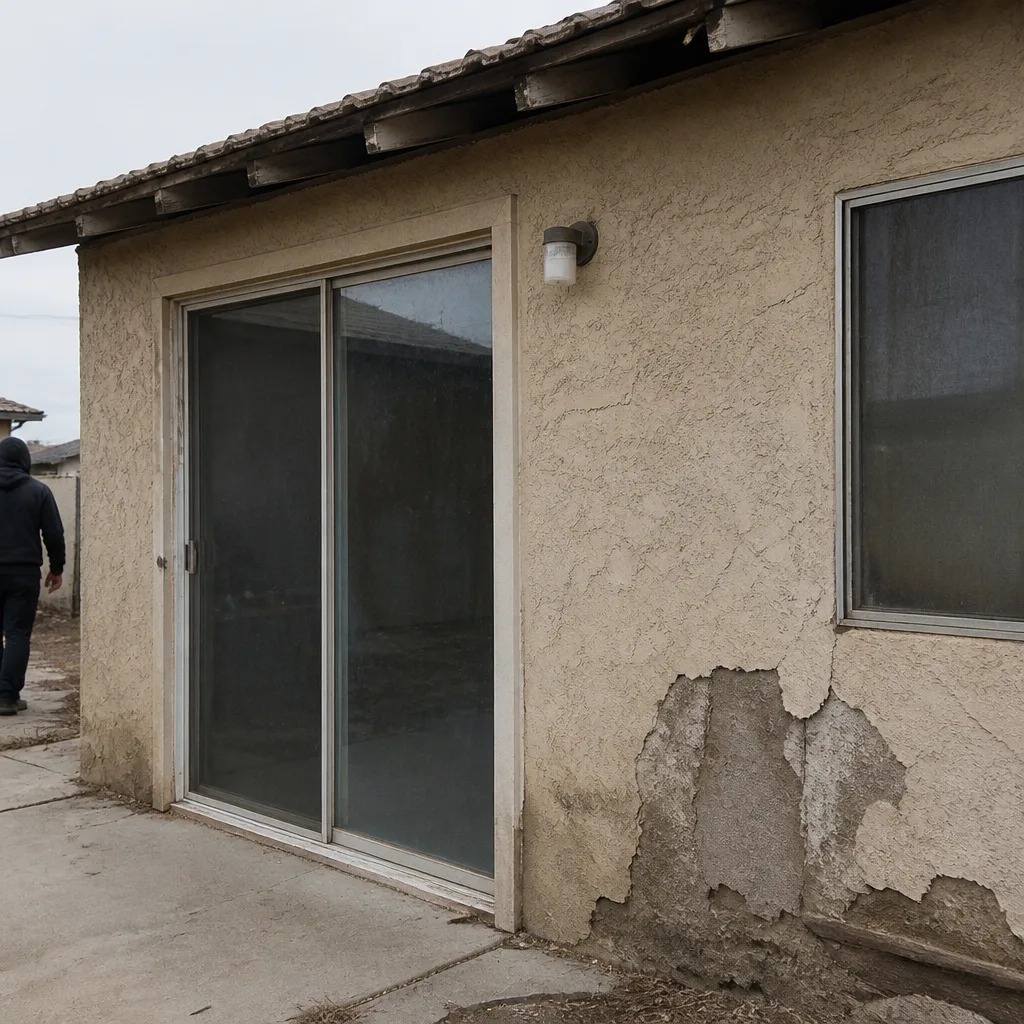 Before
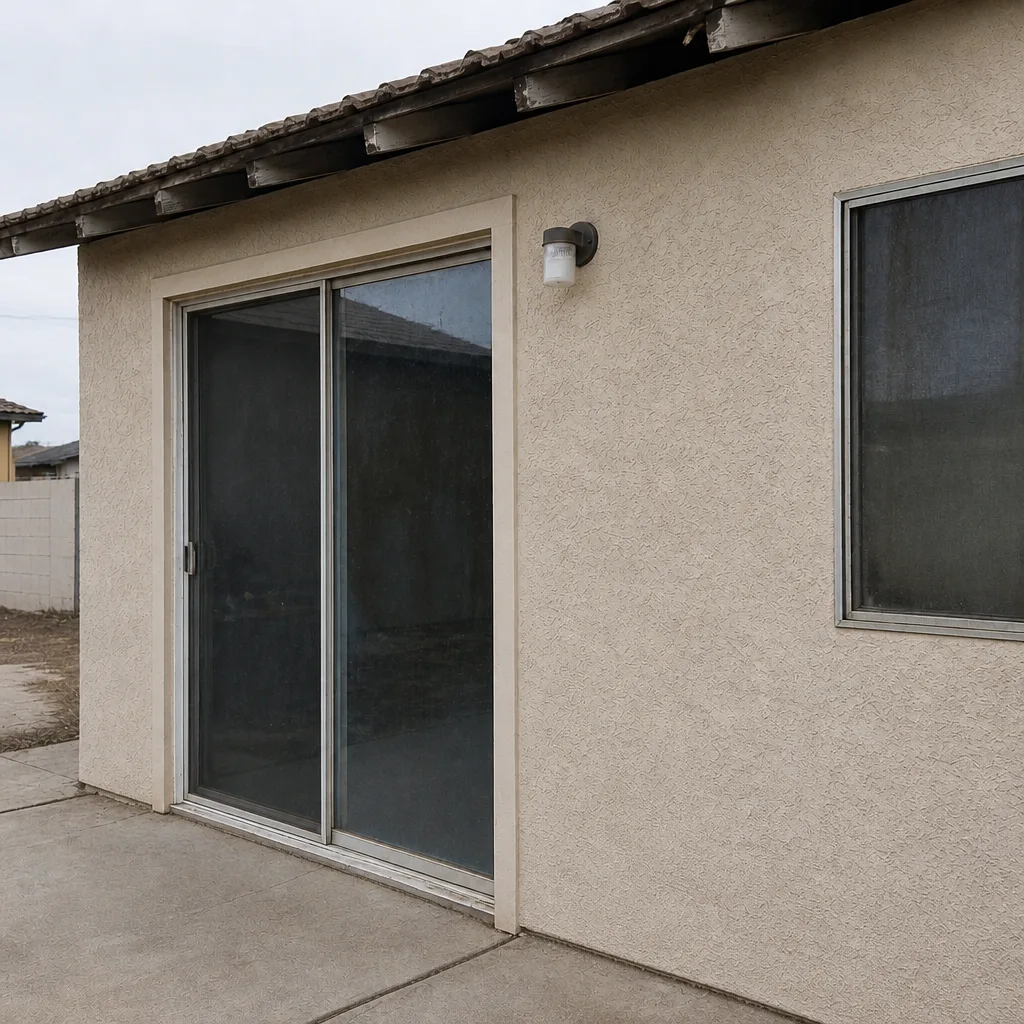 After
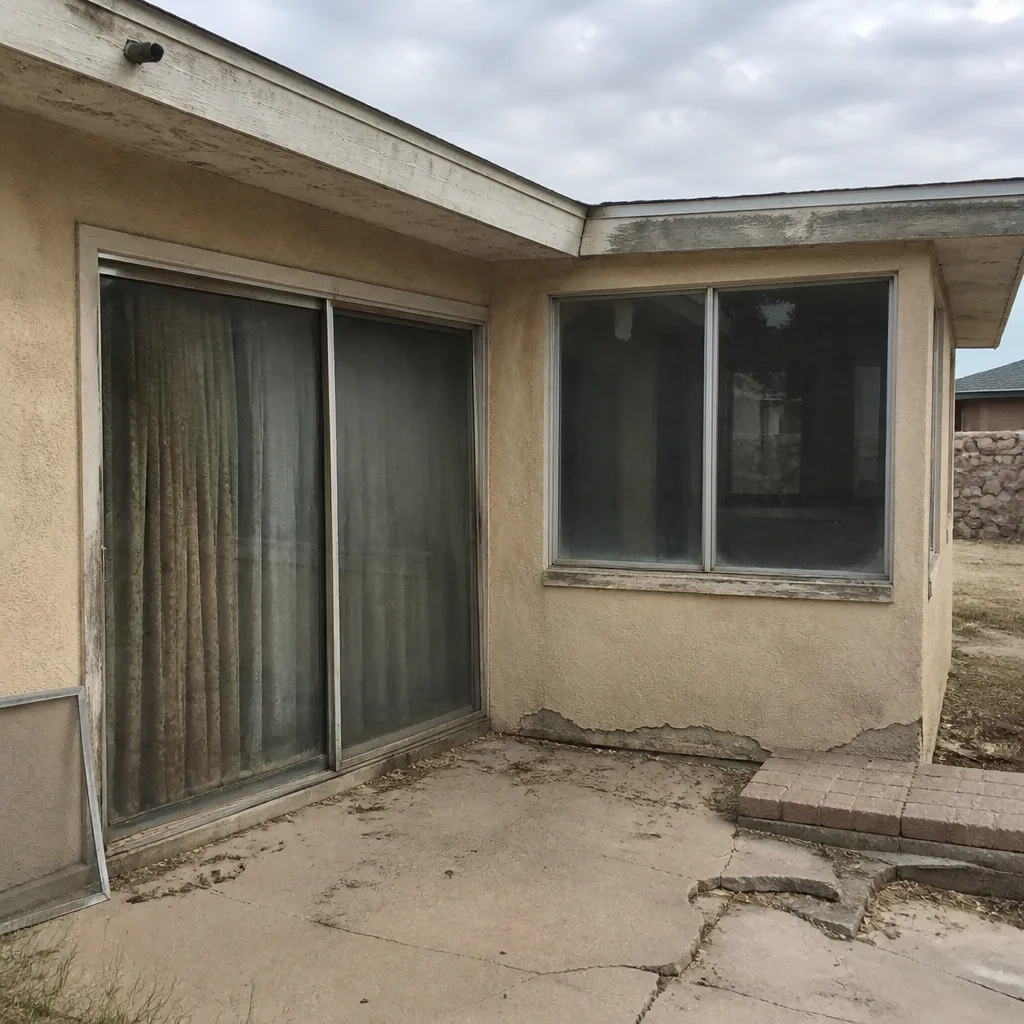 Before
 After
 Before
 After
When to Call a Professional
Call a professional if any of the following is true: the door frame has moved (verified by the hinge, level, or scribe test), the sill is soft under paint, the low-e coating has failed by the hand test, the IGU has failed internally, or the weatherstripping has compressed and you’ve already replaced it once in the last five years. Also call if you’re not confident reading the tell apart from the noise; false alarms are fine, missed structural issues are not. For anything involving the glass itself, the IGU, or a door frame that has moved, the work involves materials and measurements that a homeowner with a weekend and a YouTube playlist cannot safely or correctly handle. For minor hardware adjustments and gasket replacement, a careful homeowner can manage most of it, but the seal replacement, sill repair, and door frame work belong with a professional. TruePane Windows & Doors Boulder City offers free estimates in Boulder City. Call (844) 560-0350 to schedule yours.
Frequently Asked Questions
Replacing one failed insulated glass unit (IGU) in a Boulder City home typically runs a few hundred dollars per unit, with the exact price driven by the unit’s size, the glass package (impact, low-e, or standard), and the manufacturer. The frame is usually not replaced, which is why the IGU repair is often less than a quarter of the cost of full window replacement. Call (844) 560-0350 for an exact quote. Estimates are free.
Rub it with your thumb. External condensation wipes away with a paper towel and burns off by midday; internal condensation doesn’t wipe off and never lifts because it’s trapped between the panes. An internal fog is a failed seal and needs glass replacement. An external fog is a normal Boulder City spring-morning effect and needs nothing.
A soft spot means the wood under the paint has lost integrity, usually from water traveling along the grain from the sill-to-frame joint. In Boulder City’s dry climate, the visible bubble often trails the real rot by two or three years. Even a quarter-inch of thumb pressure give is a finding. Call a professional to inspect before the damage reaches the rough opening.
Sometimes. If the racking is minor and the frame can be brought back to plumb with re-shimming and hinge resetting, the door can often stay. If the caliche foundation has moved significantly, the frame itself may need resetting or the door may need to be refit to the new opening. A professional should measure the opening before the repair plan is set. Call (844) 560-0350 for a free assessment in Boulder City.
On a clear afternoon, hold the back of your hand about three inches from the interior glass surface. A working low-e coating feels only faintly warm; a degraded one feels noticeably warm, near plain glass. Confirm with a white-paper test: hold white paper behind the glass from inside and compare against open room light. If the coating is gone, the IGU needs replacing. The window’s rated SHGC is no longer being met.
Usually not for seal failures, rot, or coating degradation, because those are considered maintenance-related wear items in standard homeowner policies. Storm damage and impact damage are often covered. Read your policy and ask the adjuster before you file, because a filing that gets denied can still affect your premium in some policies. For any window or door failure, a written inspection first is the right order of operations.
The Bottom Line
The warning signs that matter in Boulder City are the quiet ones: internal condensation, sill rot under fresh paint, racking door frames on caliche, low-e coating that has quietly left, and weatherstripping that has flattened past usefulness. All of them are testable with your hands, a flashlight, and thirty minutes on a spring or fall morning. None of them get cheaper with time, and all of them are orders of magnitude less expensive now than two summers from now. Run the walkthrough, write down the findings, and when a finding needs a professional eye, get it looked at. That’s how a Boulder City home stays dry and tight for the next twenty years.
If a warning sign on this list needs a closer look, call us at (844) 560-0350 for a free estimate. A live person answers every call, 24 hours a day. We measure every opening twice, quote manufacturer lines on paper so you see exactly what you’re buying, and back every job with The Keystone Standard and the 90-Day Done Right Promise. If the pane is not true, the job is not done.
Our technicians have up to 18 years of experience. TruePane is an authorized installer for more than a dozen manufacturer lines, including Andersen, Pella, Marvin, Milgard, PGT, CGI, ES Windows, and Therma-Tru. Visit our TruePane Windows & Doors Boulder City home page for the full picture, or learn how we handle window installation in Boulder City when a repair is no longer the right answer.
Written by the team at TruePane Windows & Doors Boulder City.