
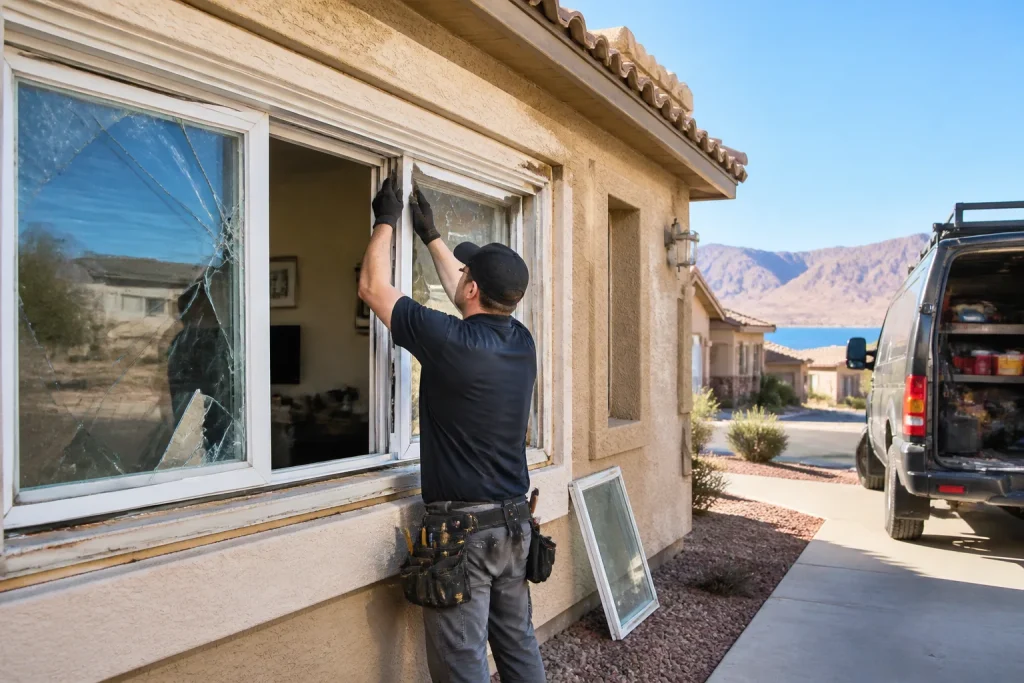
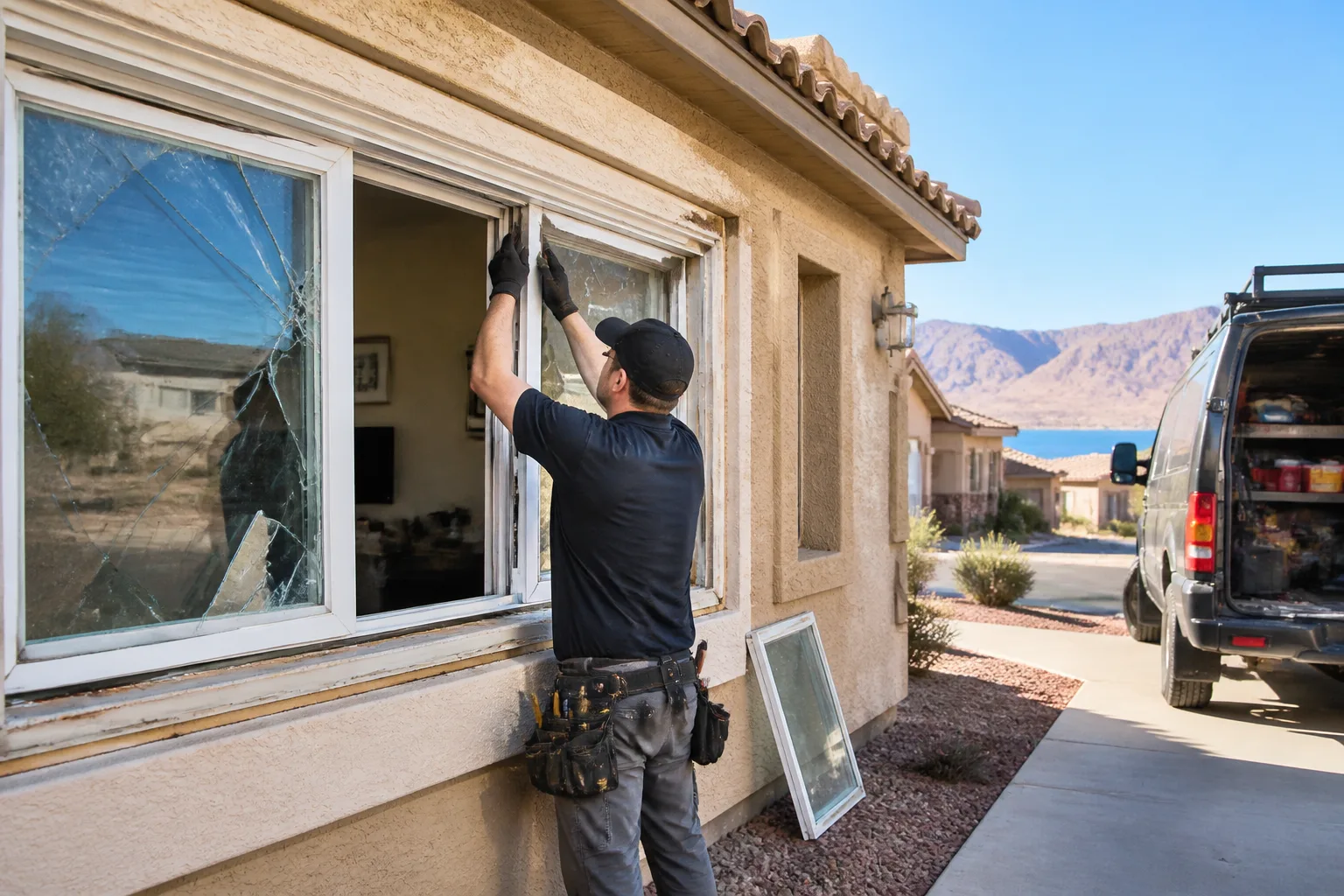
Emergency Window Installation Near Me: What Boulder City Homeowners Should Do First
A broken window in Boulder City in July can turn a west-facing living room into an oven in under two hours, and the first thirty minutes decide how the rest of the job goes. Before you call anyone, secure the opening: that single step protects your home, protects your warranty, and keeps you in control of the estimate you get. Most homeowners skip it, then spend the next week dealing with an inflated quote and a rushed install. If you’d rather not do that part yourself, call (844) 560-0350 and we’ll walk you through it.
Why the First Thirty Minutes Matter More Than Which Company You Call
Boulder City sits in a high-desert basin where summer afternoons regularly cross 105 degrees and the wind comes off the McCullough Range with real force behind it. A shattered pane lets that air in, and it also lets in grit that finds every gap. Within an hour of a break, desert dust is settling into the sill and the track, and if rain is on the way – as it does during monsoon season from July into September – you have water working against drywall and framing.
Here’s the mistake we see most often. A homeowner calls a glazier first, gets told “we can be there in an hour,” and then stands in the doorway watching a truck pull up before they’ve done anything to the opening. Now the crew is quoting against a clock, the homeowner is rattled, and nobody has measured anything properly. The quote that comes is higher than it should be, and the install that follows is the kind that fails inspection six months later.
Stabilizing the opening first flips that dynamic. You’re not calling from a position of panic. You have a secured opening, you can take your time with the conversation, and you can ask the questions that separate a real glazier from a same-day operator. We’ve pulled more than a few emergency installs apart over the years, and the ones that fail almost always trace back to a rushed first hour.
How to Secure a Broken Opening Before Anyone Arrives
Do this before you pick up the phone. It takes fifteen minutes and changes the whole job.
- Clear the area and put on gloves. Broken glass from a double-pane unit leaves slivers inside the frame that cut through leather work gloves. Sweep the floor, then vacuum, then sweep again. Glass hides in grout lines and carpet.
- Remove loose shards from the frame, not the opening. Anything that’s already free should come out. Anything still seated in the sash stays until a technician with the right tools is on site. Prying a stubborn shard is how fingers get cut.
- Board the opening on the outside if you can safely reach it. Use 1/2-inch plywood cut roughly two inches larger than the opening on every side. Tape it with exterior-grade construction tape – not painter’s tape, which lets go in desert heat within an hour. Secure with screws into the framing, not into the window sash. This is the board that holds against Boulder City wind.
- If you can’t reach the outside, seal from the inside with 6-mil plastic sheeting and exterior tape. Stretch it tight across the opening and tape to the wall, not the frame. Blue painter’s tape and duct tape both fail once the afternoon sun hits them. 6-mil plastic with a construction-grade tape is what actually holds.
- Photograph everything before you touch a thing. The broken glass, the frame, the sill, the wall around the opening. Insurance and warranty claims both want to see the state of the window before anyone worked on it.
One thing that voids future warranty claims: taping directly to the glass surface or the finished frame with an aggressive adhesive, then leaving it in the sun for a week. The adhesive cures into the finish and the next installer has to sand it off. Tape to the wall, not the window.
What “Emergency” Actually Means in Glazier Terms
“Emergency” in our trade means an opening that can’t be secured, a window that’s letting in water, or a break that’s created a safety hazard – exposed glass edges, a unit that’s lost its structural integrity. That’s the definition a glazier uses.
What installers often use “emergency” to mean on an invoice is simply “we came out on a Saturday.” Those are two different things, and the difference usually shows up as a line item. Same-day availability shouldn’t be the first filter you apply. It should be the last, after you’ve confirmed the company can do the work correctly.
In Boulder City, the practical test is this: what’s the plan for the opening right now, tonight, and tomorrow morning? A company that can answer that question – and put the answer in writing – is doing emergency work. A company that can only promise to be there in an hour is selling speed.
The Questions to Ask Any Company Taking Your Emergency Call
Ask these before anyone gets in a truck. The answers tell you more than any review will.
- Will the measurement be remade on-site, or pulled from stock? A proper install starts with a fresh measurement of the rough opening, taken by a technician on site. Stock units fit stock openings, and most homes in Boulder City aren’t stock – the housing stock here runs from 1930s bungalows to mid-century ranch builds to newer construction in the foothills, and the rough openings vary more than you’d expect. Ask explicitly.
- What happens if the stock unit doesn’t fit the existing rough opening? Every installer has a story about a stock window that came back short or long. The right answer is that the opening gets remade to spec, or the unit gets ordered to size with a documented timeline. The wrong answer is “we’ll make it work.”
- Is the work permitted? Window replacement in Boulder City generally requires a permit for structural changes and for most full-unit replacements, and the specifics depend on your scope. Ask who’s pulling it and who’s responsible for the inspection.
- What’s in writing before you touch the glass? Scope, price, timeline, and warranty registration timing. If the company won’t put the scope in writing before work starts, that’s your answer.
- Who’s registered to receive the warranty? Manufacturer warranty layers need to be registered in your name, in writing, with durations stated. That registration often has a deadline. If nobody’s tracking it, you may be holding a warranty that was never activated.
We’re an authorized installer for more than a dozen manufacturer lines, including Andersen, Pella, Marvin, Milgard, PGT, and CGI, and we quote manufacturer lines side by side on paper so you can see exactly what you’re buying. If you’d rather have that conversation than a pitch, call (844) 560-0350.
Why Boulder City Temperature Swings Break Rushed Installs
Sealant cures on a curve. The manufacturer’s instructions on the tube say one thing; the actual performance depends on the temperature at install time and the temperature over the next 48 hours. Boulder City gives you a 30 to 35 degree swing between a cool morning and an afternoon in the high nineties or low hundreds from May through September. That swing matters.
A rushed emergency install often gets sealant applied in the afternoon heat, when the frame and the substrate are both at peak expansion. The sealant skins over fast, bonds imperfectly, and then the frame cools and contracts overnight. What looked fine the next morning may have a hairline gap that opens over the next two seasons. That gap is where thermal performance goes, and it’s the reason a window that was sold as energy-efficient can test at half its rated value within a few years.
In our experience working Boulder City homes, the honest install is the one that accounts for cure time. That may mean the temporary seal stays on for a day while the new unit gets set properly – which is the right call, not a delay. If a company’s emergency pitch is that they can install and finish in the same afternoon during July, ask them how they’re managing sealant cure in 100-degree heat. The answer you get tells you a lot.
One more thing about our climate: the desert sun breaks down exterior sealant faster than anywhere else in the country. The windows we service in Boulder City need exterior sealant refreshed on a shorter cycle than the manufacturer’s national schedule suggests. That’s not a sales point, that’s just what the sun does here.
What Written Documentation You Should Have Before Anyone Touches the Glass
Before a single piece of broken glass comes out, you should have the following in hand. If a company resists putting these in writing, that’s a sign.
- The job scope in writing. What’s being replaced, what’s being repaired, what’s staying, and what happens if the rough opening needs adjustment.
- An upfront price, in writing. No “we’ll know once we get into it.” If the scope is genuinely uncertain until the unit is out, the price for the known work should still be fixed, and the scope for any additional work should be quoted before it’s done.
- Permit responsibility. Who’s pulling it, who’s paying for it, who’s meeting the inspector.
- Warranty registration timing. Both manufacturer layers registered in writing, durations stated, and the date the registration was completed. This should be before the installer leaves your driveway.
- Workmanship warranty terms. What the company backs, for how long, and how a claim gets made.
Every job we do is covered by our 90-Day Done Right Promise and The Keystone Standard, which means both manufacturer warranty layers are registered in writing before the truck leaves the driveway. No arguing, no paperwork fights. If it’s not done right, we make it right.
When to Call a Pro
Board the opening yourself. Then call a pro for anything involving the frame, the rough opening, the sealant, the sash, or the glass unit itself. Window installation is a dimensional business, and the difference between a window that performs for thirty years and one that fails in three is usually a quarter inch of measurement and a properly cured seal. There’s also the safety side: high windows, second-story openings, and large units are genuinely dangerous to handle without the right equipment and training, and a fall from a ladder with a piece of glass in your hands is not a risk worth taking. Our technicians have up to 18 years of experience, they’re background-checked and uniformed, and they measure every opening twice.
A broken window in Boulder City also isn’t the moment to guess at glass type. Impact-rated units, energy-efficient units, and standard units all have different requirements, and picking the wrong one creates a code problem at inspection. That’s a conversation worth having before anyone measures.
Related services in Boulder City: If your break turns into a full replacement, see Window Replacement in Boulder City. For new construction or full-frame work, Window Installation in Boulder City. For openings where the glass and the door are both involved, Door Installation in Boulder City. And to learn more about how we work, visit TruePane Windows & Doors Boulder City home.
The Bottom Line
Secure the opening first. Photograph everything. Then call, with questions ready – not panic. The company that answers with specifics about measurement, permits, and warranty registration is the one worth hiring; the one that answers with speed is the one to be careful about. A rushed emergency install in Boulder City in July is a warranty problem waiting to happen, and the homeowner who takes fifteen minutes to board the opening properly controls the entire rest of the process.
If you’re in Boulder City and need help, TruePane Windows & Doors Boulder City offers free estimates – call (844) 560-0350. A live person answers 24 hours a day, 7 days a week, and we’ll walk you through securing the opening before anyone gets in a truck.
Frequently Asked Questions
Most emergency window work in Boulder City lands in the $350 to $900 range for a temporary stabilization plus a single standard-size unit, and climbs to $1,200 and up for large or impact-rated units that have to be ordered. The single biggest cost variable isn’t the glass – it’s whether the rough opening needs to be remade or can accept a correctly sized stock unit. Call (844) 560-0350 for an exact quote – estimates are free.
It shouldn’t. We quote an upfront price with the scope in writing, and any additional work gets quoted before it’s done – not billed after. If the rough opening needs adjustment once the unit is out, that gets priced before anyone touches it. The one thing that does change a price is scope change, which is why we put the scope in writing first.
We handle permit responsibility as part of the job, and we can tell you upfront whether your specific scope requires one. Most full-unit replacements do; emergency stabilization and board-up typically don’t. The permit question should get a clear answer on the first phone call, not after the truck arrives.
A single-unit emergency replacement is usually a one-visit job once the correct unit is on site. Board-up happens the same day you call. If the unit needs to be ordered to your opening’s exact size, expect a lead time on the unit itself – but the opening stays secured and weather-tight in the meantime. Most jobs we do are completed in a single visit.
Call (844) 560-0350 to schedule your free estimate. We’ll tell you what we can do, what it costs, and when.
Written by the team at TruePane Windows & Doors Boulder City.
Need Windows & Doors Help?
Call TruePane Windows & Doors Boulder City - licensed & insured, here with fast after-hours help in Boulder City.
(844) 560-0350